A reader wrote this week to ask a question I hear in one form or another all the time: his genealogy research shows that he descends from a well-documented early colonial North Carolina ancestor. He has an AncestryDNA kit. He has looked for other descendants of this ancestor among his matches. He is not seeing them. He wanted to know why.
If you have deep colonial roots in eastern North Carolina, you have probably had the same sinking feeling. The family is huge, the line is well-documented. You would think the DNA test should light up. And then the surname search comes back thin, or empty.
That result is not, by itself, evidence that you are out of the family. Autosomal DNA was never built to confirm a tenth great-grandparent one match at a time. Here is why, without more science than the question needs.
The short version
Autosomal tests (AncestryDNA, 23andMe, MyHeritage, Family Tree DNA’s Family Finder) are excellent at finding people who share ancestors within about five or six generations. After that, two things start happening at once.
First, you only inherited detectable DNA from a fraction of the people that far back. The rest were shuffled out as chromosomes recombined, generation after generation.
Second, even when two descendants of the same 1600s man both kept a scrap of his DNA, those scraps usually do not overlap — or the overlap is too small for the testing company to show as a match.
As an example, a well-documented Blount ancestor who dies in the late 1600s or early 1700s, such as Capt. James Blount (d. about 1686) sits at about tenth-great-grandparent distance for most of us living now. At that range you should not expect a cluster of matches whose trees say “Blount.” You also should not read a blank surname search as evidence you are not in the family.
What searching for the surname actually finds
There are really two different searches people think they are running.
In our example, one is a search of your DNA match list for trees that mention the surname Blount somewhere. On a big kit, that search will often return someone. The name is not rare, the family was large and well-documented, and a lot of testers have at least a scrap of a Blount in a tree.
The other search — the one people mean — is “show me people who still carry the name Blount, or whose trees are built all the way back to Capt. James, and who share DNA with me because of him.” That is a much taller order.
Most descendants of Capt. James do not still answer to Blount. After ten generations the name is usually on a daughter’s line, three or four or more surnames back from the tester, if the tree is built that far at all. Most testers’ trees are not built that far. A filter for the living person’s last name, or for a complete path to 1686, will miss almost everyone who actually belongs in the descendant pool.
There have been articles about the Blounts on this site before. I have never personally met one. They exist. The paper trail is not the problem, but expecting the surname to still be sitting on the match’s tree, three hundred and forty years later, is the problem.
How the DNA thins out
You inherit about half your autosomal DNA from each parent, about a quarter from each grandparent, and so on. That halving is an average, not a promise. By the time you are counting eighth and tenth great-grandparents, the average from any one person is a sliver — and many of those people left nothing in you that a testing company can see.
An eighth great-grandparent is ten generations back. There are 1,024 ancestral slots in that generation (fewer if your tree folds in on itself, which eastern North Carolina trees do). The DNA you expect from any one of those people is about one part in 1,024 — roughly a tenth of one percent, or about 3 to 4 cM. Ancestry’s matching threshold sits around 8 cM. A lot of real 8th-great DNA never gets reported.
A tenth great-grandparent is twelve generations back: 4,096 slots. The expected share from Capt. James himself is usually under 1 cM. Often it is zero.
Here is the same idea in a table. “Will they match you?” means another person who also descends from that same ancestor, not the ancestor themselves.
| Shared ancestor | Gens back | Slots in that gen. | Expected DNA from one | Another descendant matches? |
| Parent | 1 | 2 | ~50% / ~3,400 cM | Always |
| Grandparent | 2 | 4 | ~25% | Always |
| Great-grandparent | 3 | 8 | ~12.5% | Always |
| 2nd great (2nd cousins) | 4 | 16 | ~6% | Almost always |
| 3rd great (3rd cousins) | 5 | 32 | ~3% | Usually (~90%) |
| 4th great (4th cousins) | 6 | 64 | ~1.6% | About half the time |
| 5th great (5th cousins) | 7 | 128 | ~0.8% | Often they don’t |
| 6th–7th great | 8–9 | 256–512 | a few cM, or none | Unreliable |
| 8th great | 10 | 1,024 | ~3–4 cM, often 0 | Rare |
| 10th great (example: Capt. James Blount) | 12 | 4,096 | under 1 cM, often 0 | Almost never from him |
Company figures line up with that table. Roughly 90 percent of third cousins share enough DNA to show as a match. About half of fourth cousins do. Fifth cousins drop into the 15–30 percent range depending on the company. Eighth cousins are under 1 percent. Ninth and tenth cousins are little more than a rounding error. Those percentages are for true cousins who really do share only that one distant couple. They are not a promise that the segment you do see came from the famous name on the chart.
The eastern North Carolina problem on top of the math
Even when two people with Blount in a tree do share 8, 12, 20 cM, that segment is not automatically Capt. James Blount.
Early colonial North Carolina was a small world. So was eastern North Carolina well into the 1800s. The same river neighborhoods married the same river neighborhoods. Families that look unrelated on page one of a tree are often related two or three other ways by page four. That phenomenon is called endogamy and pedigree collapse.
So a match whose tree reaches a documented Blount, and whose kit shares a small segment with yours, is consistent with a shared colonial eastern-North-Carolina background. It is not proof of that one 1686 man. The likelihood of other shared ancestors is high. That is true whether the surname on the match is Blount, Reed, Slade, Blount again through a daughter, or something that never looks like Blount at all.
Small segments are also the zone where identical-by-chance pile-ups live. Companies hide or down-weight a lot of that on purpose. A 7 cM “Blount” match that does not triangulate with anyone else on a documented child of Capt. James is not a finding. It is noise until the paper and the other testers say otherwise.
What to use instead, at that depth
If the question is “do I descend from Capt. James Blount,” autosomal matching is the wrong primary tool. The right ones are older and slower, and they still work.
The records. Walk the line person by person — wills, deeds, estates, guardian bonds, county court, the published compilations checked against the originals. The Blounts of Mulberry Hill / Chowan material is extensive. Use it, and then go past it to the courthouse pages the compilations rest on.
Y-DNA, if the suspected line is father to son to son. A Big Y test on a living man who believes he is a direct male-line Blount can place him in (or out of) a documented Blount haplogroup cluster. Autosomal tests cannot do that job. The surname on an Ancestry match list cannot do that job either.
Closer autosomal cousins. DNA becomes useful again when you come forward. If you can document a great-great-grandparent who is a known Blount descendant, and you match other testers who document that same great-great, that is the range where autosomal DNA earns its keep. The 1600s man is then supported by the paper plus a cluster in the 1800s — not by a surname search aimed at 1686.
A built tree on the kit. ThruLines and surname filters only know what testers typed. If your own tree stops in 1870, Ancestry cannot tell you that a match’s 4th great-grandmother was a Blount. That is not a DNA failure. That is a tree failure.
A note for the rest of us with 1600s people
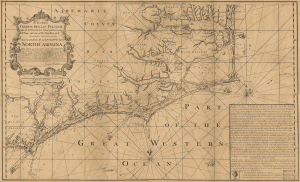
This is not a Blount-only problem. It is the same math for a Moseley, a Blount neighbor on the Albemarle, a 1733 map surname, a Tuscarora-war-era family, or anyone you are tempted to “confirm” by scrolling a match list for the famous name.
I use DNA constantly on this site — autosomal, X, Y, and mtDNA — but I use each kind for the distance it can actually reach. Autosomal DNA is how you find the living people who share your 3rd and 4th great-grandparents. It is not how you prove the immigrant. When I argue a colonial identification here, the spine of the argument is still the record. The DNA is allowed to support, to contradict, or to stay silent. Silence at ten generations is the normal result, not a verdict.
If you have been staring at a match list wondering why the big colonial family did not show up, you are not doing it wrong. The test is doing what the test can do. The rest is still the work we were doing before the kits arrived.
If you want to go further
Blaine Bettinger’s Shared cM Project (the interactive version at DNA Painter) is the chart most of us keep bookmarked for “how much DNA does this relationship usually share.” The ISOGG cousin-statistics page publishes the company figures for how often cousins of each degree even appear as a match. I used both of those, plus the usual generation-halving arithmetic, for the table above.
If you have questions or comments, please leave them below.