I have thoroughly enjoyed poring over the pages in the the only surviving folder from the colonial and early statehood eras for the Pitt County Court of Pleas and Quarter Sessions (Bonds 1762–1851, Land Records 1778–1779, 1793–1797, Wills 1762–1851).
Among the standard bonds and tax lists and loose papers, I stumbled upon a very cool document that I had never seen before — and it left me with lots of questions.
This isn’t for an ancestor (that I know of), but it’s for Joel WALL, a man who seemed to have a lot of interactions with many of my ancestors, including a separate land grant with my 5th-great-grandfather, Talbot WILLIAMS.
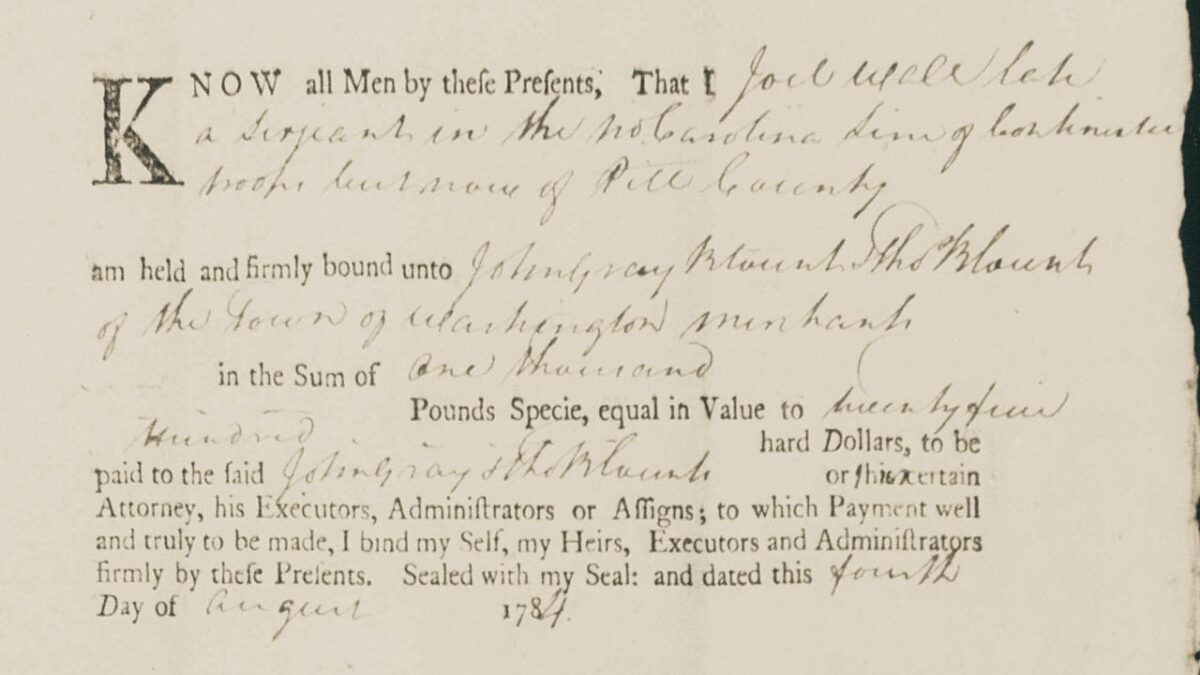
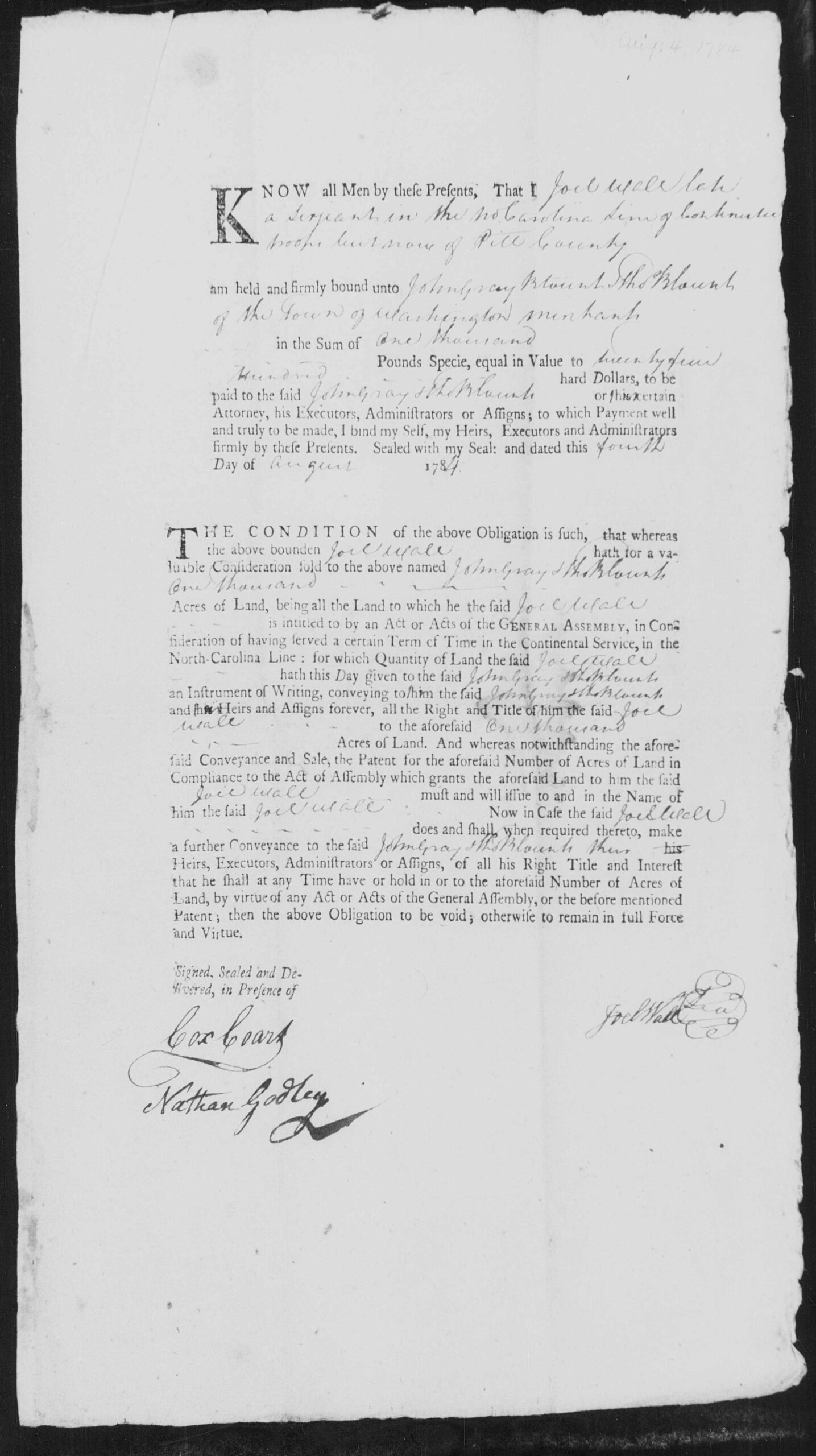
The document I found was a 1784 “Bond for Deed” that didn’t appear anywhere on the standard land registries for Pitt County. And it specifically says, “That I, Joel Wall Sen. a Serjeant in the No Carolina Line of Continental troops but now of Pitt County, am held and firmly bound until John Gray Blount & Thos Blount of the Town of Washington merchant in the sum of one thousand Pounds Specie, equal in value to twenty five hundred hard Dollars to be paid to the said John Gray & Tho Blount or their certain Attorney, his Executors, Administrators, or Assigns; to which Pament well and truly to be made, I bind my Self, my Heirs, Executors and Administrators firmly by these Presents. Sealed with my Seal: and dated this fourth Day of August 1784.”
After the boilerplate language, it goes on to describe that Joel Wall was entitled to a tract of land by Act of the General Assembly for serving a certain time of service in the Continental Army for North Carolina (which would be in Tennessee, though the document doesn’t specify that). He is going ahead and signing over his rights to that future land grant and trading it in on some “valuable consideration” for the present.
I wondered what the “valuable consideration” might be, so I asked Google Gemini. Here’s what it said:
“Valuable Consideration” is a catch-all legal phrase that deliberately hid the actual purchase price. In 1784, North Carolina’s economy was a disaster, paper money was nearly worthless, and Continental veterans were cash-starved and desperate.
The Blount brothers were notoriously shrewd businessmen. While we don’t know the exact amount they gave Wall, historical records of similar transactions show that speculators typically bought these military land rights for pennies on the dollar. Instead of $2,500 in hard cash, Wall likely received:
- A tiny fraction of that amount in actual cash, OR
- A horse, a gun, or some livestock, OR
- (Most likely) Store credit at the Blount brothers’ merchant trading post in Washington, NC, to buy supplies, sugar, cloth, and iron tools.
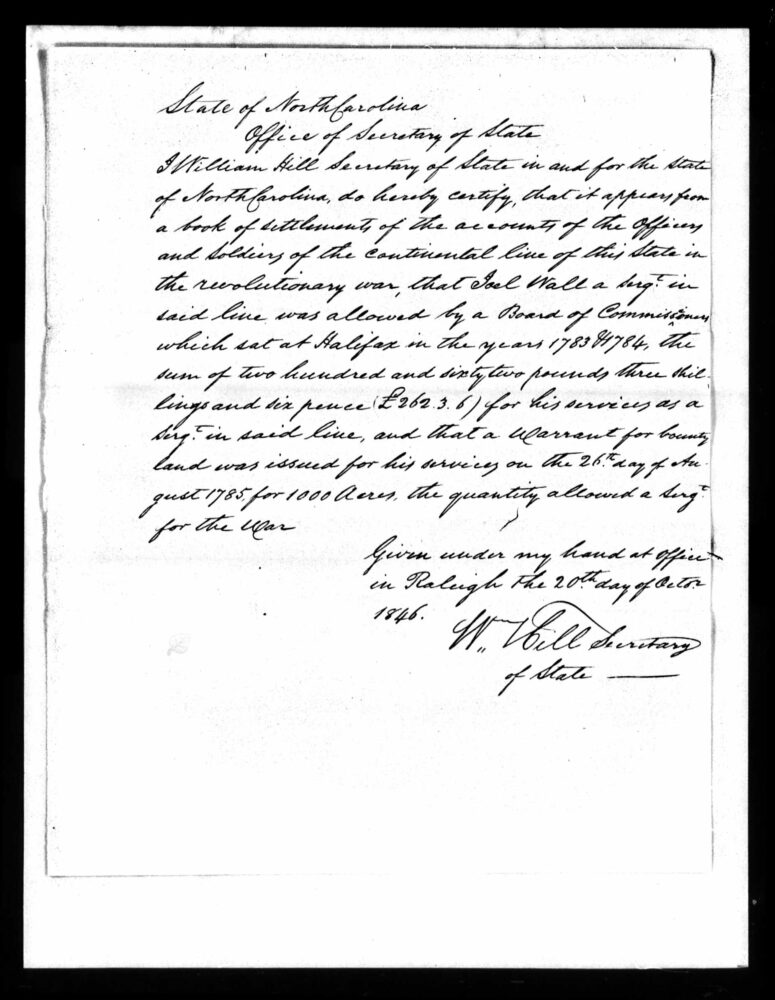
But it turns out I already had an additional piece to this puzzle in my Ancestry profile about Joel Wall from his Revolutionary War pension application.
So, what did Joel Wall actually get paid that day?
From the item above, we can read that just months prior, a Board of Commissioners had met in Halifax, NC, to settle up with cash-starved Continental veterans. They awarded Sergeant Wall £262.3.6 in back pay alongside his 1,000-acre land warrant.
But there was a catch. The state paid these back-wages in paper “specie certificates” (which I have learned were essentially state IOUs). Those were rapidly depreciating in value in the post-war economy. Joel Wall was facing a mountain of bureaucratic paperwork, including back-pay certificates and a future promise of land across the mountains in Indian Territory, but he couldn’t use any of that paper directly to feed his family or buy the supplies he needed to live and thrive there in Pitt County.
So along come John Gray Blount and Thomas Blount. They were a couple of Mr. Moneybags with a bustling merchant trading post right in Little Washington. They were able to offer veterans a way to cash out without waiting on all of the state’s financial pieces to fafll into place. While we don’t know the exact cash or store credit exchange, there’s a good chance he just traded his speculative 1,000-acre wilderness warrant to the Blounts for immediate, tangible goods, tools, or usable currency.
I guess in a way, it’s like the Blounts were the J.G. Wentworth of the day. 😂
“I have a military land grant but I need cash now!”
“Call J.G. Wentworth – 877-Cash Now!”
But seriously, Joel Wall basically liquidated his paper military assets for immediate financial relief, and the Blounts gambled on a massive future empire in what would become Tennessee.
But don’t think it was immediately profitable for the Blounts. They weren’t able to enjoy use of that land anytime soon. In fact, it was nearly a decade before Joel Wall’s actual military grant was issued, and anyway, that particular time frame there were still Indian wars happening in the frontier west of North Carolina and into Tennessee. You can view the actual mlitary warrant pages at NC Land Grants (https://nclandgrants.com/frame/?fdr=1051&frm=759&mars=12.14.2.2071)
I learned about some interesting history from the details in the land grant.
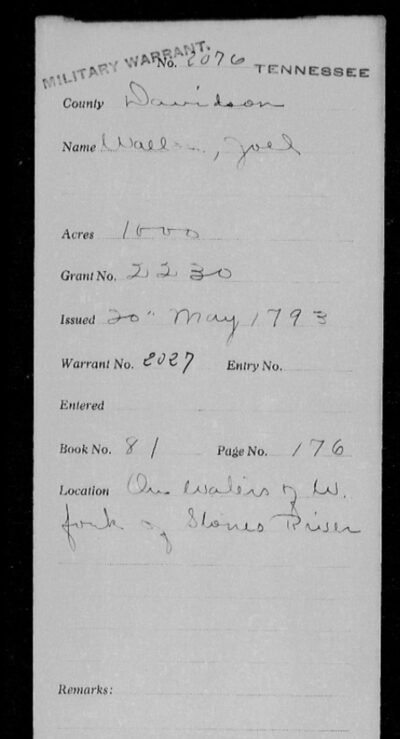
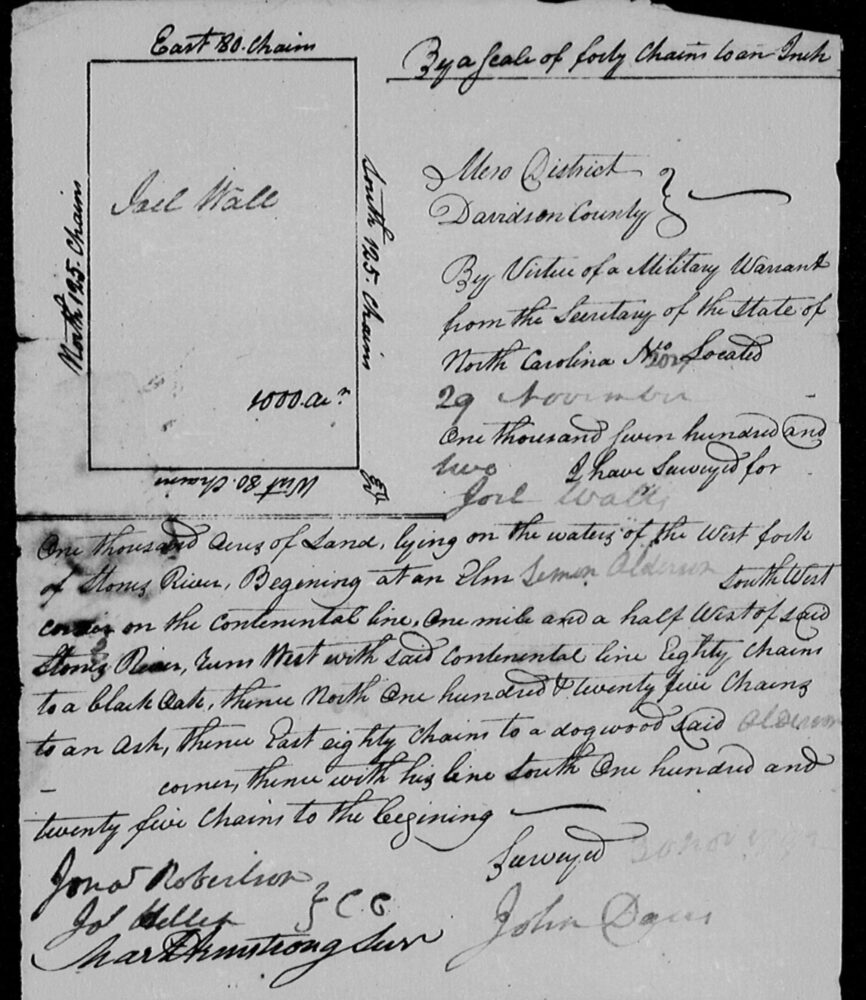
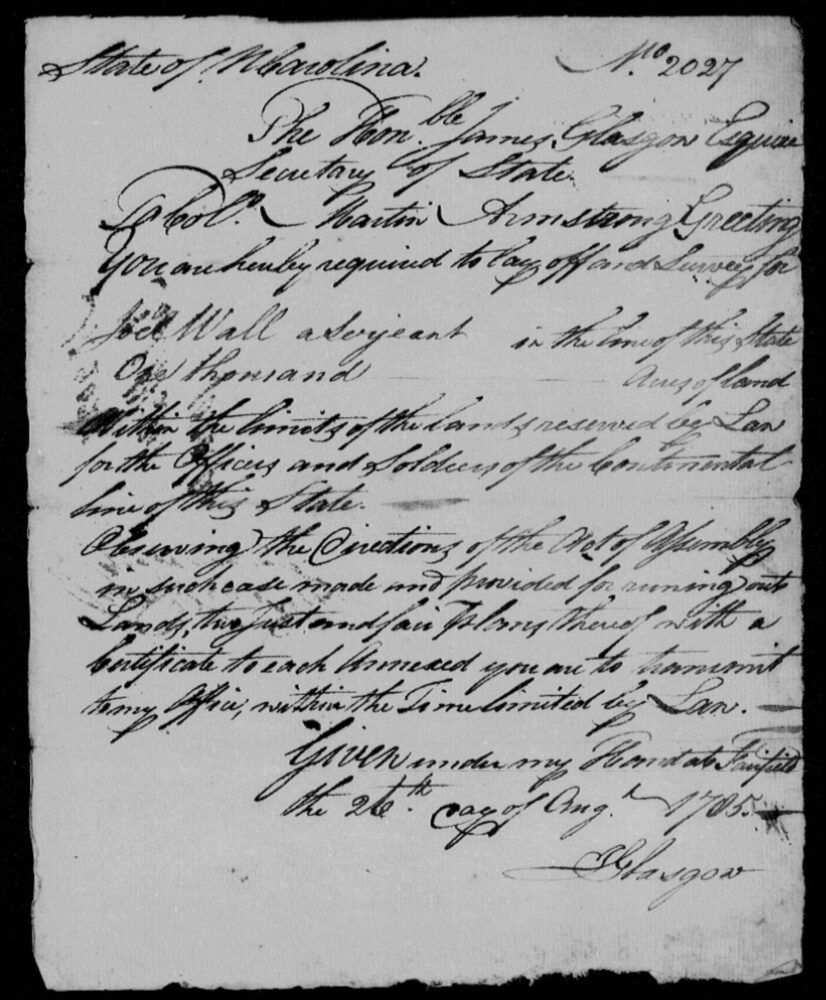
Historical Details in the Documents
- The Signature of an Infamous Scoundrel: The 1785 military warrant is signed by James Glasgow, North Carolina’s Secretary of State. Just over a decade later, Glasgow would be disgraced in the infamous land fraud scandal for masterminding a massive ring that forged Revolutionary veteran signatures to steal Tennessee land. Nearly all of us who have been researching colonial North Carolina will have seen James Glasgow’s notorious name appear on land grants of our ancestors.
- The “Mero District”: This one was completely new to me. The 1792 survey plat explicitly notes that the land was in the “Mero District” of Davidson County. What in the world is that? Well, I’ve learned from Gemini that it turns out this district was named after Esteban Rodríguez Miró, the Spanish Governor of Louisiana (of all people!). This was evidently a nod from western settlers who felt abandoned by North Carolina and were subtly flirting with Spain for protection and trade access to the Mississippi River. (This wasn’t the first time folks in the western parts of North Carolina were annoyed with their government. Think back on the War of the Regulation in the years prior to the Revolutionary War.)
- Frontier Royalty on the Property: The survey plat lists the “Chain Carriers” (the men who physically measured the land) as Jo. Kelley and Jona. Robertson. Jonathan Robertson was the son of James Robertson, the legendary explorer known as the “Father of Middle Tennessee” and founder of Nashville. Surveying along the West Fork of the Stones River (near modern-day Murfreesboro, TN) in 1792 was highly dangerous due to ongoing warfare with Chickamauga Cherokee and Creek Indians; these chain carriers were as much bodyguards as they were surveyors.
Why did the bond end up in that particular Pitt County Court folder?
I also asked Gemini about this one because I couldn’t figure out why it hadn’t already been filed away in the John Gray Blount papers or elsewhere. Here’s what it told me:
Normally, when a title bond’s conditions were met and the final deed was signed over, the bond became legally void and was either thrown away or kept in private family papers. The fact that this original document stayed in the hands of the Pitt County Court of Pleas and Quarter Sessions means something likely went wrong.
By May 1793, the land grant was finally official. The Blounts needed Joel Wall to sign the final conveyance. If Wall had passed away, moved, or refused to sign, the Blounts would have been forced to bring this 1784 bond into the Pitt County courtroom as physical “Exhibit A” evidence to sue his estate or force his heirs to honor the contract. The lawsuit ended, but the piece of paper remained in the clerk’s bundle for the next 242 years.
Joel Wall was still alive as late as 1810 when he and John Chapman were engaged in a law suit to which a couple of my ancestors were subpoenaed to appear as witnesses. We know he died in
I have yet to meet any descendants of Joel Wall, but I know they must be out there. If you descend from him, please comment below. I’d love to say “Hello!”
PS – Since in the bond I found it styles him as Joel Wall Sen, it suggests he was the older Joel Wall and there was a younger one. That wouldn’t necessarily be his son. Although since we don’t see that he had a son named Joel until he had one born in 1806, I wonder if he had a son named after him when the bond had been issued, but who had passed away by the time the 1806 Joel Wall Jr. is born. If any of you know if there was another Joel Wall contemporaneous to this one, other than the hypothetical son, please let me know.