

UPDATE [31 Aug 2026]: X-DNA comparisons on GEDmatch (strict SNP thresholds) between a lady who is an X-DNA descendant of Nancy Morris, Jean Cratch (an X-DNA descendant of Laban Morris’s mother), and the Jane Holmes / Selah Averitt direct mtDNA descedants including my grandmother Beatrice Morris, as well as her sister and Janette Loftin Mills (another direct mtDNA descendant of Jane Holmes) do not support two ideas I argued in the post below: that Nancy Morris is Serenia Averitt, and that Laban Morris and Selah Averitt share a mother.
The records and the neighborhood pattern stand. The DNA part does not. Levi Morris × Sally Holmes and Roland Morris × Sophia Holmes remain a sufficient explanation for much of the autosomal clustering. I am leaving the original argument below so the reasoning is still readable, and I will correct specifics as I rewrite. I explain what went wrong in Family Tree Fact-Checking Myself! Correcting the record about Laban Morris and Selah Averitt (7 September 2026).
Using a combination of Y-DNA, mtDNA, autosomal DNA and X-DNA, we’re zeroing in on a few facts with relative confidence:
- Father of Laban Morris: Rowland Ledbetter, most likely the son of John Ledbetter and Elizabeth Wesson. (Evidence: yDNA, autosomal DNA)
- Mother of Laban Morris: Name unknown.
Video removed — 31 August 2026. I took the YouTube video down so it would not keep circulating without the correction.
X-DNA work on GEDmatch does not support two claims I made in that talk: that Nancy Morris is Serenia Averitt, and that Laban Morris and Selah Averitt share a mother. The documents in this article still stand. The DNA interpretation does not. Read the update at the top of this post before the original text.
Documentary Evidence
Identity & Name
- Laban was born approximately 1780/81 in eastern North Carolina
- His legal surname at birth was Henly or Henby — the printed 1810 private session laws record it as “Henly” but the handwritten legislative document appears to say “Henby,” suggesting a transcription error that has misled researchers
- He went by Morris socially at least as early as 1805, suggesting the Morris name carried personal meaning he was unwilling to abandon even before formalizing it
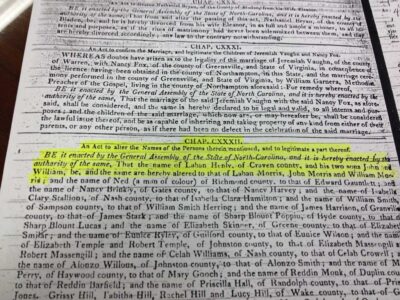
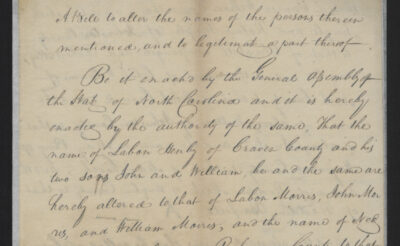
- In December 1810, the NC General Assembly legally changed his name to Laban Morris, and also changed the names of his sons John and William — a deliberate move to protect the next generation from the same legal vulnerability. Unlike other name changes in 1810, Laban and his sons were not being “legitimated”, but rather they were just having their names changed. The petitions from 1810 seem to be missing from the State Archives.
- The name Laban itself was never passed down to any of his children or grandchildren, suggesting he had no warm attachment to it
Possible Early Household Placements
- It’s possible that Laban was living in Elisha Morris’s household in Chocowinity in 1790 — Elisha Morris was a longtime neighbor of John Holmes Sr. in that community. There were three boys under 10 in Elisha’s household. One could be Elisha’s son Josiah Manker. The next could be Elisha’s son Thomas. The third boy is unidentified, but he’s the right age to be Laban.
- After Elisha Morris’s death, Laban may have been in John Nelson’s household in 1800 — John Nelson being the man whose land bordered the Hardy Gatlin tract Laban later purchased in 1814
- If correct, this explains Laban’s close relationship with Turner Nelson, John’s son — Laban later signed a document with other Swift Creek men hiring Turner Nelson as a teacher in their community
- In a letter Turner Nelson wrote back to James Roach in Swift Creek in 1825, the last paragraph specifically mentions Laban and it only uses his first name, unlike every other name in the letter. (Incidentally, James Roach was about Turner Nelson’s age, but he was named an executor in David Averitt’s will so he might have worked for or with David Averitt and that might be why Turner is mentioning this to James in this letter.)
“I want you to Show this Letter to Laban and let him know that it is my wish for him to come to this Country with them Boys of his and not stay there on that old field of Ald ELISONS Spending of his time in that place and sinking himself to destruction tell his wife that her Sister Sally is well and has two fine Boys that goes to School to me at this time if he will come I know his chance will be better here than there. I conclude by wishing you to remember me to the whole family and remaining.”
The Militia Connection — 1781
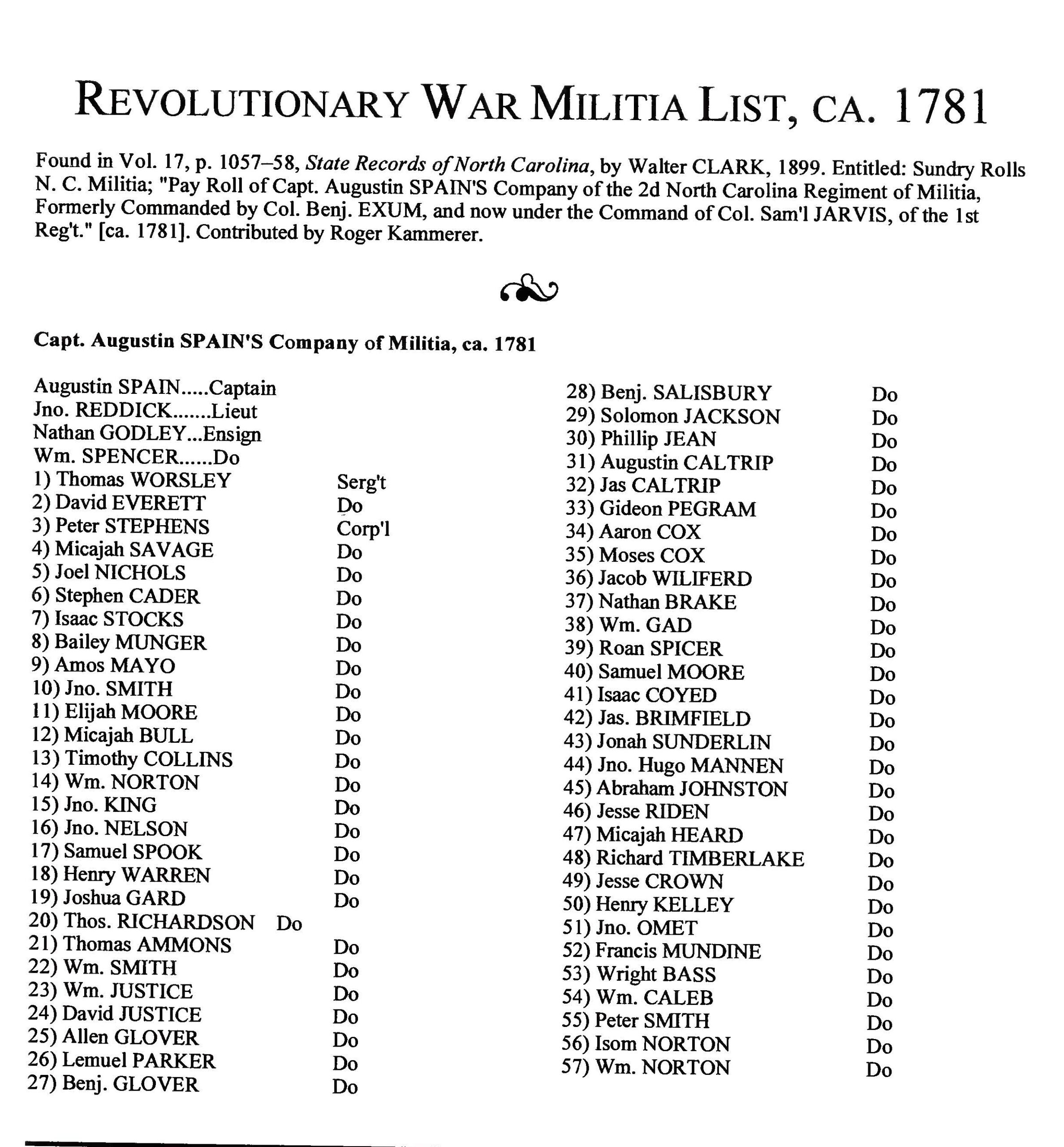
- In 1781, Captain Augustin Spain’s company of the 2nd NC Regiment of Militia included David Averitt, John King, John Nelson, and Micajah Bull among its members (David Averitt is listed as David Everett; Micajah Bull dies by 1798 and David Averitt buys from his estate while John King serves as administrator).
- John King was one of the two bondsmen on Laban’s 1805 marriage bond — the other being John Williams
- John Nelson was Laban’s neighbor in the 1814 Gatlin land transaction, with Nelson’s line forming a boundary of that tract, plus John Nelson is the father of Turner Nelson so if Laban is the mystery teenager in John Nelson’s home in 1800, that might explain how he would’ve had a close relationship with Turner who was just a baby at the time.
- John Nelson’s nephew, Nathan Nelson, marries the widow of Elisha Morris after Elisha dies. In 1805, that same Nathan Nelson was involved in a “riot” with children of Benjamin and Anna (Morris) Lancaster, as well as a William Morris who later marries Polly Bull, daughter of Ambrose Bull.
Presence in Swift Creek
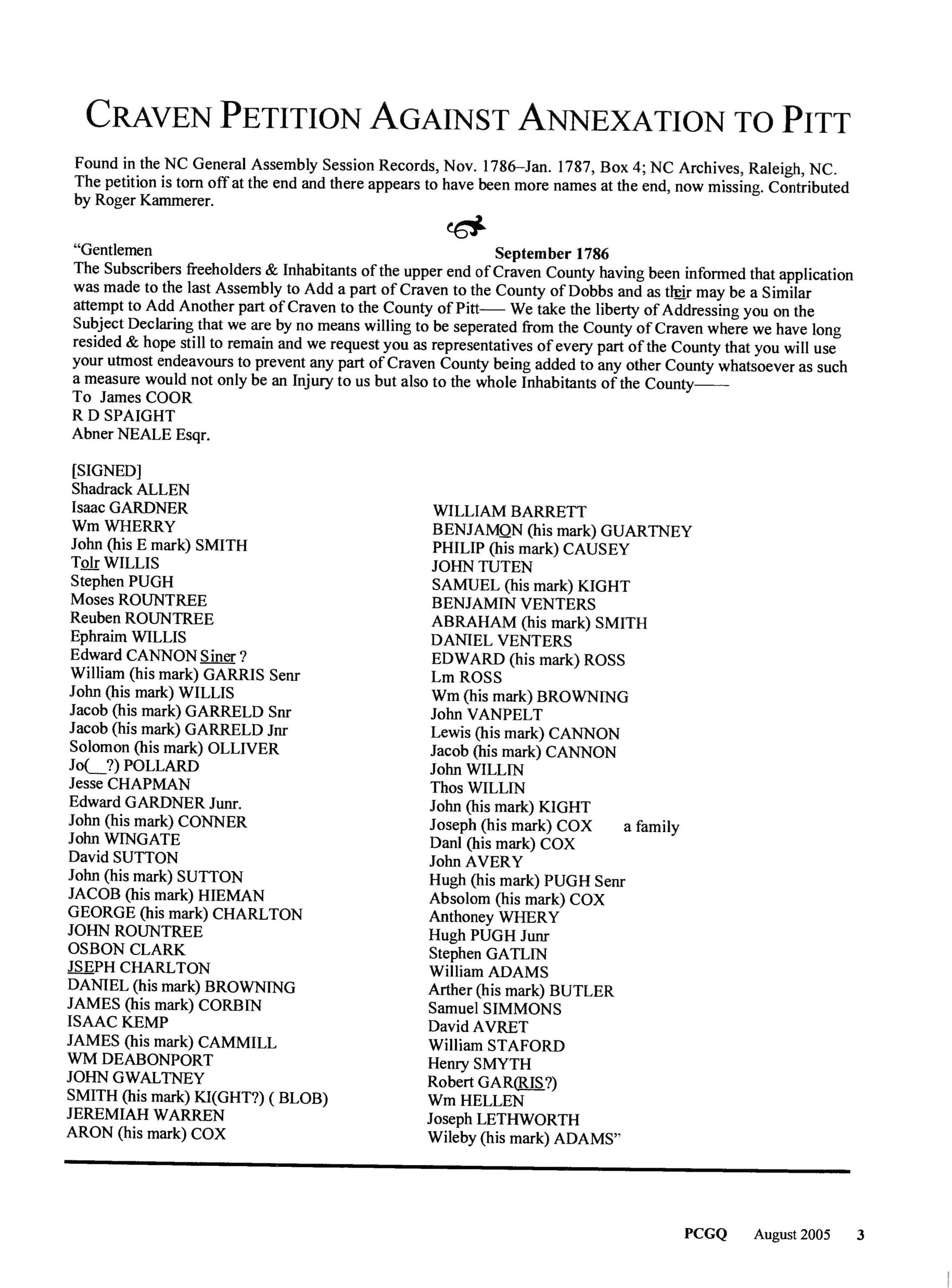
- While he was already living in Swift Creek as early as 1786 (per his signing of a petition against the annexation of part of Craven County to Pitt County), David Averitt purchased 100 acres on the south side of Swift Creek in December 1804, with Joel Wall as witness.
- Joel Wall and Talbot Williams (the father of Laban Morris’s wife, Kitty Williams) obtained a land grant together in June 1803.
- An 1817 estate document after the death of Joel Wall specifically describes his land as bordering David Averitt, Talbot Williams, and John Chapman.
- Laban Morris first appears in the records of Swift Creek on his 1805 marriage bond
The 1810 Court Case as Catalyst
- In 1809–1810, Laban was subpoenaed as a witness along with David Averitt and others in John Chapman vs. Joel Wall, a civil action in Craven County
- He was summoned by both sides, indicating he was a central eyewitness
- He was summoned as “Laban Morris” — a name with no legal standing in the county records, other than that marriage bond signed for by John King and John Williams
- The name change petition followed later that same year, almost certainly prompted by whatever happened at the courthouse relating to his legal name versus the one everyone knew him by.
- Joel Wall, the defendant in that case, had also witnessed David Averitt’s 1804 land purchase — placing Laban, David Averitt, and Joel Wall all within the same tight community network (which makes sense since the next year is when Laban marries Kitty Williams)
The Only Land Laban Ever Bought
- In 1814, the heirs of Hardy Gatlin sold Laban Morris a 200-acre patent tract on the north side of Swift Creek and north side of Mauls Swamp for $200
- This tract bordered John Nelson’s land — the same John Nelson in whose household Laban may have lived around 1800
- Laban held it for approximately one year then sold it to Hiram Pollard for the same $200 he paid — breaking exactly even, suggesting he was facilitating the transaction rather than speculating for profit
- This is the only piece of land Laban ever purchased in his own name; he never built on his own land or established an independent homestead
David Averitt’s First Wife — The Mystery Woman
- David Averitt’s 1828 will names his wife Sarah (Butler, daughter of Arthur Butler), sons Enoch, Arthur J., and David B., and daughters Elizabeth Anderson, Selah, and Permelia Ann
- No first wife is named anywhere in any document — she left no trace by name
- She was dead by May 1819, when David married his second wife Sarah (Sally) Butler
- She was the mother of at least Elizabeth, Selah (~1792), and Enoch. If there were other children born to her and David, there is no extant record of them.
Selah Averitt — Key Figure
- Selah Averitt, daughter of David Averitt by his unnamed first wife, was born approximately 1793
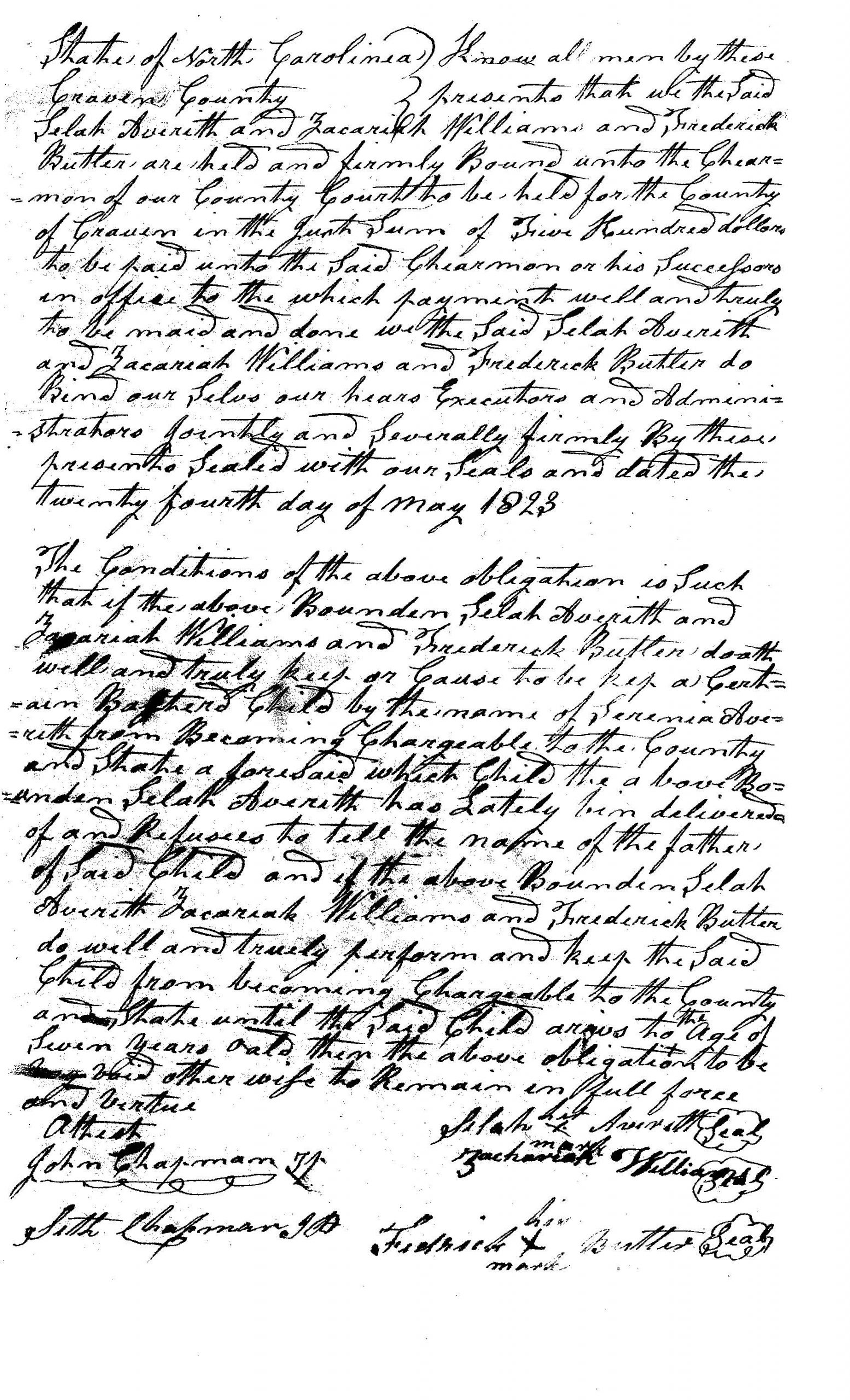
- In 1823, Selah appeared before the court on a bastardy bond and refused to name the father of her child
- The first bondsman named was Zachariah Williams — the younger brother of Kitty Williams, who was Laban Morris’s own wife
- Selah’s refusal to name the father while Zachariah Williams served as the first named bondsman is intriguing. She didn’t mind naming the father in a separate bastardy bond a couple of years later when she gave birth to Stephen Averitt. That father was Thomas Hardy.
- The child recorded as Serenia Averitt (from her bastardy bond where Zachariah Williams is the first bondsman) vanishes entirely from the documentary record after the bastardy bond
- The year after the bastardy bond with Selah Averitt, Zachariah Williams marries Nancy Manker, who is most likely the daughter of Josiah Manker, the illegitimate son of Elisha Morris of Chocowinity.
- The bastardy bond that Zachariah signed obligated him to ensure the child was being provided for until she was 7 years old. After the 1830 census, Zachariah Williams moved to Indiana.
- Selah married John Holmes Jr. about 1828 and moved to Chocowinity
Serenia Averitt / Nancy Morris
What the records still show
- In 1830 Laban and Kitty Morris have a girl in the household in the age bracket for an 1823 birth.
- A woman named Nancy Morris is in Laban’s household in 1850, listed after his known children; she is also listed that year in William Morris’s household (Laban’s second son), again after his children; and she is again with Laban in Chocowinity in 1860.
- Nancy Morris is the right age to be the Serenia named in Selah Averitt’s 1823 bastardy bond.
- Zachariah Williams (first bondsman on that bond) was Kitty Williams’s brother. Kitty and Zachariah’s mother was named Nancy.
What I no longer argue << UPDATED SECTION
Those facts made it reasonable to ask whether Nancy was Serenia, and whether she sat in that house because Selah and Laban shared a mother. X-DNA on GEDmatch, run at strict thresholds, does not support either idea in the kits available (Ruth Dennis, Jean Cratch, and the Jane Holmes / Selah testers). Nancy may still be an unrelated or differently related Morris girl in the household. The “doubly connected niece” story depended on a shared mother plus Nancy = Serenia. I am not using that construction anymore.
Laban’s move to Chocowinity late in life is a separate question and does not depend on this identification.
The McIntosh and Anderson Connections
- Enoch Averitt, David’s son by his unnamed first wife
(and therefore possibly Laban’s half-brother), married Leta McIntosh in 1820 [retracted: see the update at the top] - In 1830, Laban’s second oldest son William Morris married Susan McIntosh, Leta’s younger sister, and guess who was bondsman for the marriage bond. Enoch Averitt.
- Susan and Leta were children of James McIntosh and Susan Anderson. This same Susan Anderson is likely a sister of the Thomas Anderson Jr. who married Betsy Averitt, Enoch and Selah’s older sister.
Alpha Morris and the Holmes Connection
- Alpha Morris, Laban’s only daughter, was widowed after her first husband John Norris’s death and she’s struggling by the early 1840s, appearing in the Wardens of the Poor in 1843
- By 1845 Alpha had married William Holmes of Chocowinity — the son of John Holmes Jr. by his first wife (name unknown), making him a stepson of Selah Averitt.
- The connection between a struggling widow from the Swift Creek area and the Holmes family of Chocowinity is most naturally explained by a pre-existing family relationship
— consistent with Selah Averitt being Laban’s half-sister – otherwise, how else would Alpha have had any occasion to know William Holmes?[I no longer argue that Selah and Laban were half-siblings. See the update at the top.]
The Naming of Rowland
- Laban and Kitty’s children include no child named Rowland until their very last son, William Rowland Morris, born September 1828
- David Averitt died in January 1828
; Laban’s mother, David’s first wife, had already been dead since before 1818[retracted: Laban’s mother is unknown, and I no longer think she was David’s first wife. See the update at the top.] - By September 1828,
both people who might have had reason to feel the weight of that name were goneDavid Averitt was gone. (I originally counted Laban’s mother here too, as David’s first wife. That part is retracted.) - Laban then named his last son William Rowland Morris — suggesting he waited until it was safe to honor his biological father openly
- The Rowland name was subsequently carried forward deliberately: William Rowland Morris went by Roland, and Laban’s son Levi later named his own first son William Rowland
About DNA Evidence
Most of the DNA you inherit follows a straightforward pattern – you get roughly half from each parent, a quarter from each grandparent, an eighth from each great-grandparent, and so on. This is called autosomal DNA, and it comes from all of your ancestors in roughly equal measure.
X-DNA is different. The X chromosome follows a very specific inheritance path that skips certain ancestors entirely – and that is exactly what makes it useful for genealogy.
The rule: men have one X chromosome and one Y chromosome. A man gets his Y from his father and his X from his mother – only from his mother. A man’s X-DNA carries nothing from his father’s side at all.
Women have two X chromosomes – one from their mother and one from their father. A woman’s father could only have gotten his X from his own mother. So a woman’s paternal X traces back to her paternal grandmother – not her paternal grandfather, who contributed a Y to her father instead.
Mapping the X Path
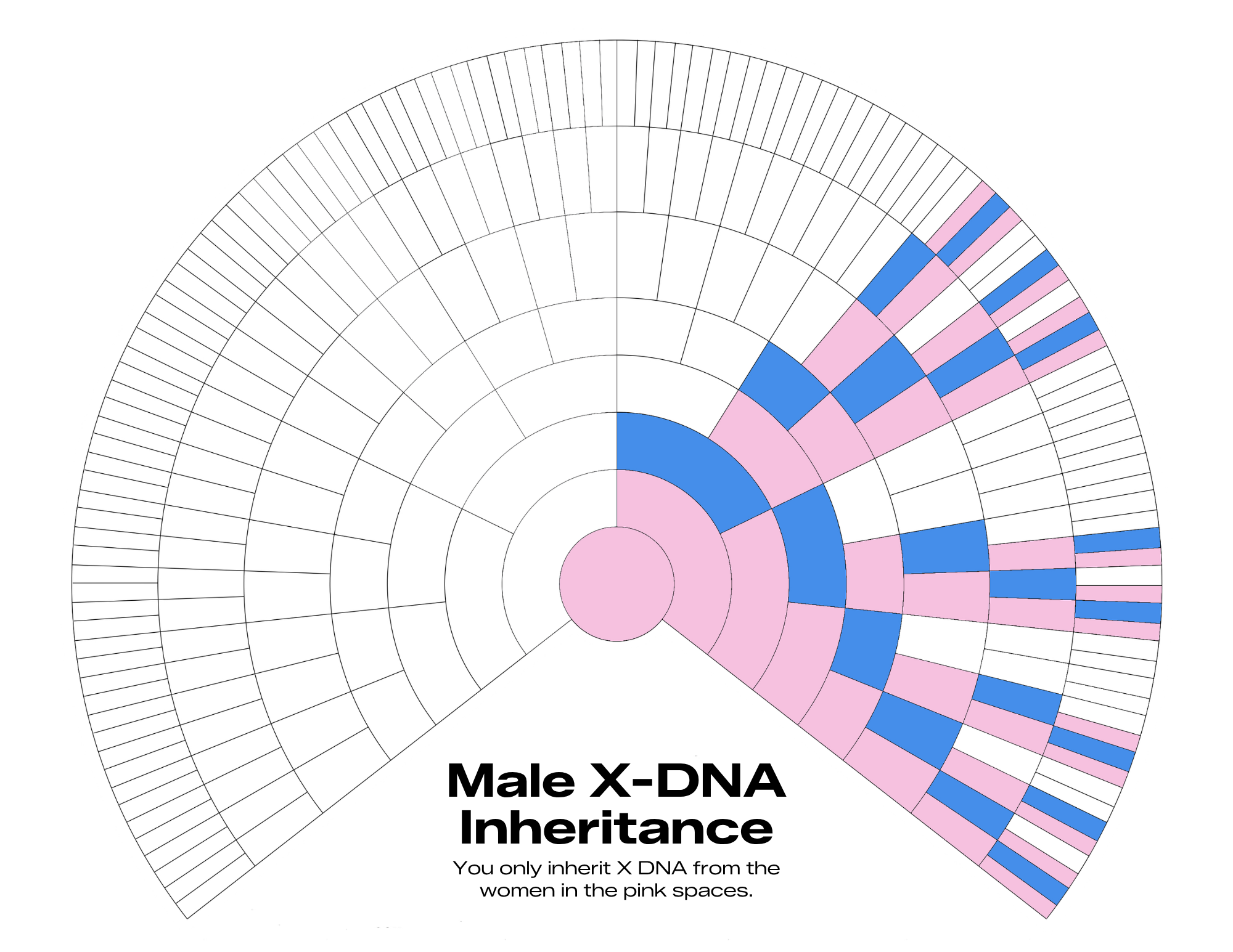
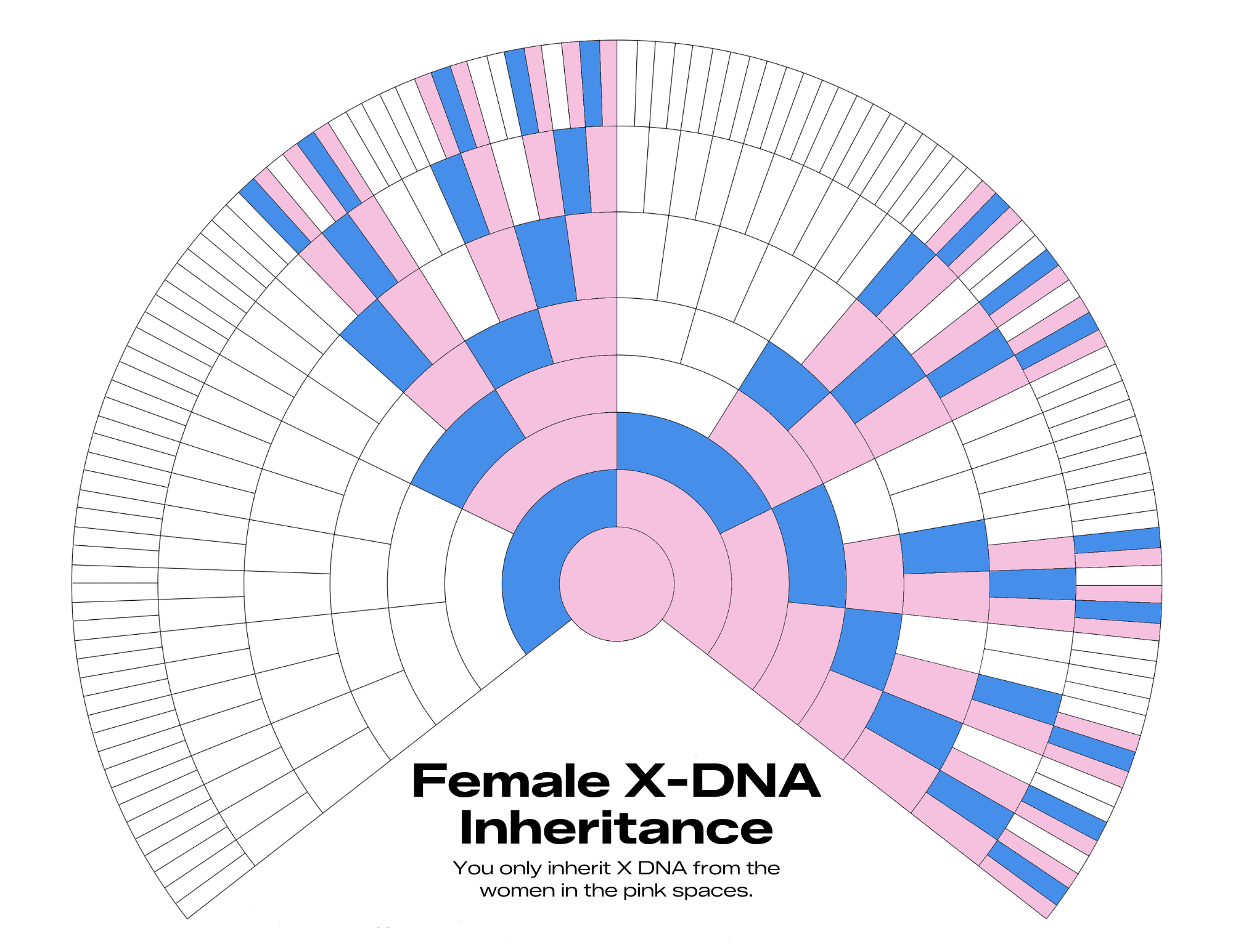
By using a Fan Chart, you can easily see which of your ancestors could have contributed to your X-DNA and which ones couldn’t have. When you work backward through the generations, certain ancestors will drop out of the picture entirely.
There are several different pathways through which X-DNA can be inherited, and women have more of those potential pathways than men do. The fan charts below can help you figure out which of your specific ancestors fall on those X-DNA paths. A match on the X chromosome narrows the field of possible common ancestors in a major way. You can only inherit X DNA from the ancestors in pink on these charts. For males, they get their mother’s side only. For females they get some from both their mother’s and father’s side.
In closing… for now.
Sometime soon, I hope to put together a database showing all of the connection points between these people. For now, hopefully, this post will help researchers of these families.
If you have any thoughts about any of this, please leave a comment below. I’m not saying that all of this is exactly how things unfolded, but boy, the pieces do all seem to line up nicely!
Related Content
- The Laban Morris Family
- Laban Morris name changed from Henly/ Henby
- Is it Henly or Henby?
- The father of Laban Morris has been identified as…
- Are these the parents of Nancy Morris?
- Letter from Turner Nelson to James Roach (1825)
- Turner Nelson hired as teacher in Swift Creek (1823)
- Levi Morris Pension Application (Very detailed!)
3 comments
Teresa Morris
I’m grateful (beyond words) Sara has stayed focus for many years of her adult life devoting an enormous amount of time, personal resources, conducting countless interviews, traveling near and far in search of ancestral ties, historical records and building an extensive ancestral DNA map. I have no doubt Sara’s ancestors would also be proud knowing she has done the work to prove or disprove ‘hearsay’ which has been passed forward amongst previous generations.
Sara Whitford
Thank you, Mom. ❤️🙏
Kendall Lasseter
This is amazing – I have been recently digging into my ancestry. I believe Laban is my 4th or 5th great grandfather from Thomas Morris -> Joseph Edward Morris -> Dolly Morris -> Otis Lasseter -> Morris Lasseter -> Mark Lasseter. Would love to connect!