Over the years, I’ve published several posts about items as I found them in the search for more information about my twice-over 5th-great-grandfather, David Averitt. Initially, I thought I had struck gold when I found items in Pitt County for a David Averitt who died in 1808 and had several children, including a daughter named Seley. (My David had a daughter named Selah) Later, I found the will for MY David Averitt in Craven County in 1828, which obviously ruled out the one who died in 1808 in Pitt County.
I have continued tracking Averitts (sometimes spelled Averett, Avett, Everett, even Avery). I have many of my data points summarized in a Google Sheet. [Tracing the Averitt Family of Beaufort, Craven, and Pitt Counties]
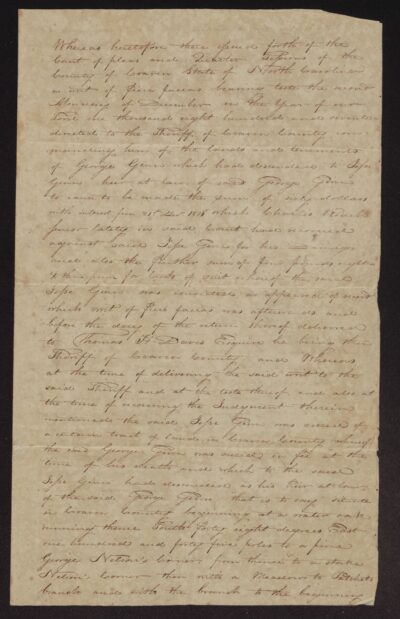
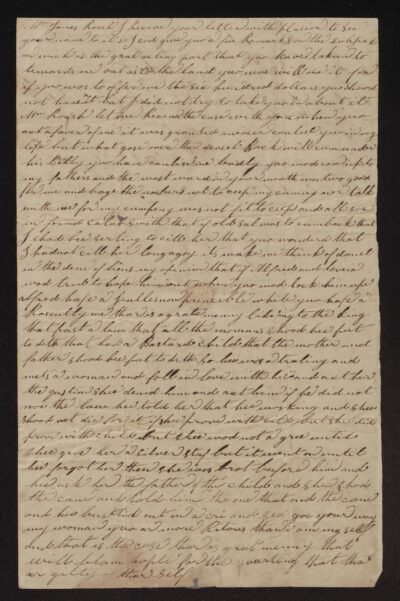
Yesterday, a fellow researcher, Robert Paramore of Beaufort County Genealogical Society, passed along a deed with a note written on the back that he came across in the William Blount Rodman Papers (Box 2) at ECU Special Collections. It was one I have never seen either on the Pitt County Register of Deeds site or Full-Text Search at Family Search, and best of all, it was the original of the deed.
It was a 1778 land transaction in which William Averrette (William Averett / William Averitt) is deeding ~150 acres to David Averrette (David Averett / David Averitt) in Pitt County on the W. side of Chicod Creek, part of a larger tract that was granted to Joseph Gadd in a patent 21 Sept 1749. The witnesses on the deed were James Cason and Joseph Boyd. (Original deed image and transcription is at bottom of this post.)
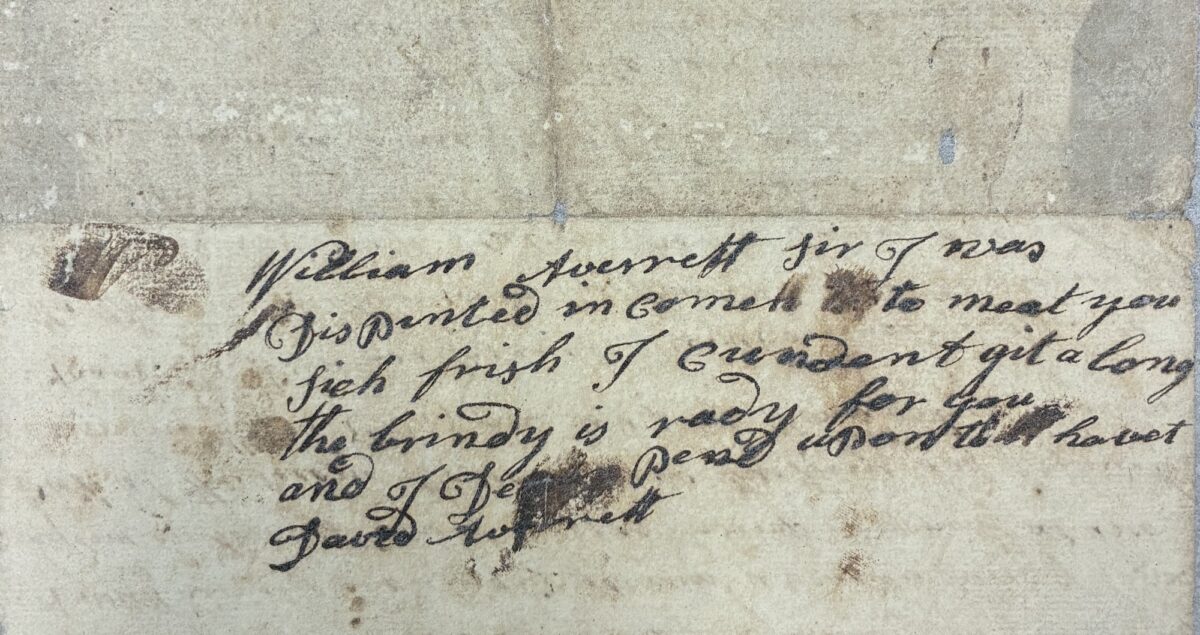
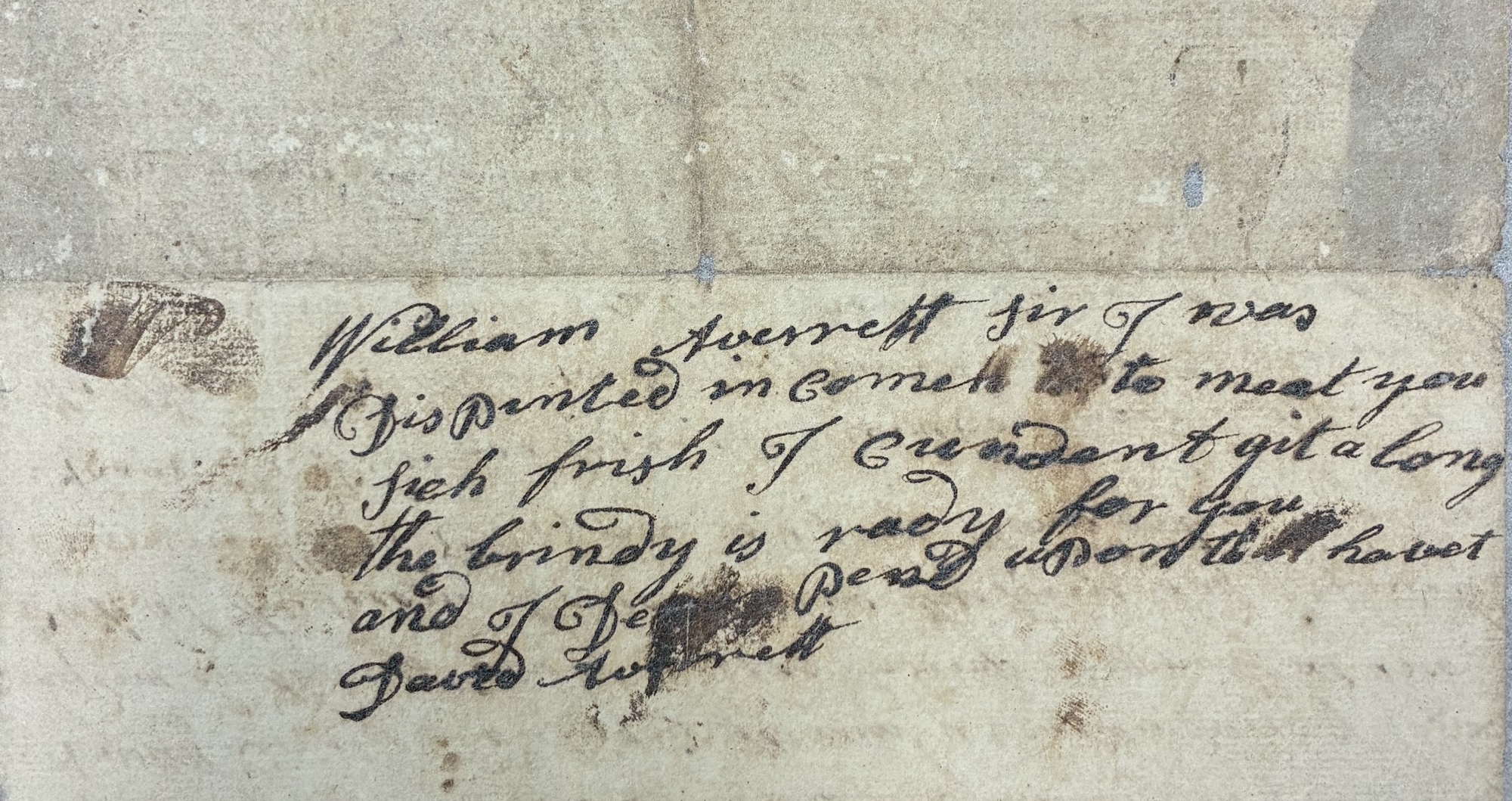
The coolest part was a note handwritten on the back from David to William. It says:
William Averrett sir I was
Dispinted in comin to meat you
sich frish I cundent git a long
the brandy is rady for you
and I Depend upon to havet
David Averrett
David was writing phonetically, as many people did in those days, so if we think about the vocabulary that was in use in those days, here’s what he was saying:
“William Averrett, Sir: I was disappointed in coming to meet you, [due to] such a fresh [“freshet” – aka flood] I couldn’t get along. The brandy is ready for you, and I depend upon [you] to have it. > — David Averrett”
If my calculations are correct, based on ages to appear on deeds as a witness or a grantee, along with military records, petitions, and census records, my guess is David Averitt was born about 1755.
How do you know that it’s your David Averitt?
The most exciting part of this handwritten note on the back of this deed is that the deed is from 1778, so this is the earliest original signature we have as a sample to compare. The deed is between William and David and connects to the Averitts who were in the northern part of Pitt County near Conetoe / Bethel area in the decades earlier.
Most deeds we see are clerk transcriptions in county deed books, so the signatures will tell us if someone signed or just made a mark, but the original deeds have the actual signatures of the people who signed them, and in this case, even though David didn’t sign the deed, the deed was to him and he wrote a note on the back.
My immediate reaction upon seeing the note above is that the signature looked the same. That’s what I wanted to know. Was there a way to definitively link my David to the family in northern Pitt County in the 1760s and 1770s? A signature consistent across decades would be the way to do it.
So take a look at this. This is a collection of signatures spanning from ~1778, to 1786 to 1826, 1828 (David’s signature on his will), and 1825. Right away to me the signatures look close enough that I am satisfied.
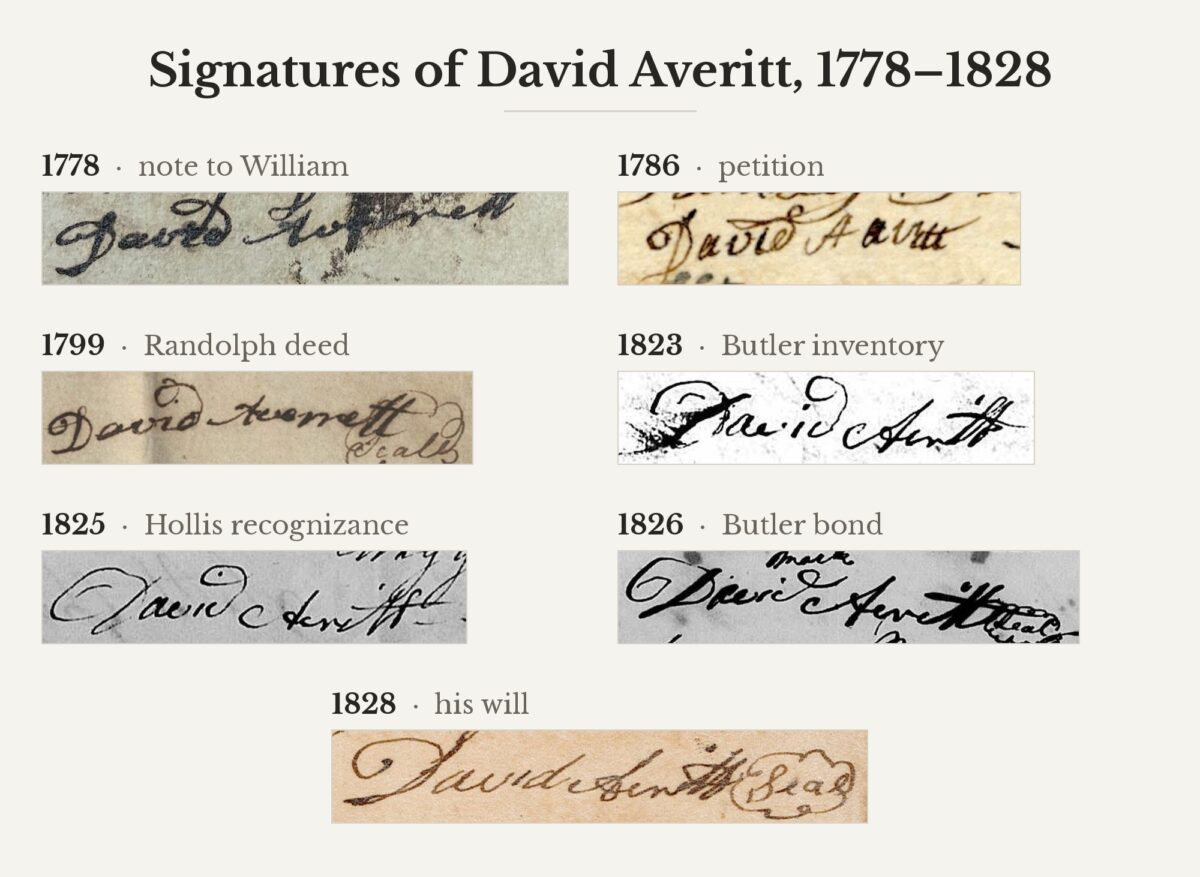
Update, November 13, 2026: After obtaining an image of the 1799 Randolph deed on November 12, 2026, I added individual crops of seven of David’s signatures with sources, replaced the original graphic, and asked my AI research assistant, Librarian, for a third opinion (below the Gemini and Claude responses).
A closer look at each signature
Here is each signature on its own, in date order, cropped from the best image I have of each original and sized to the same height.

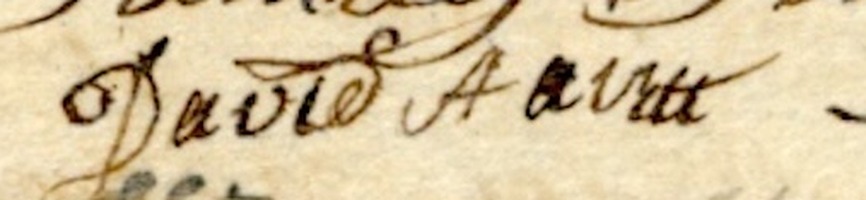
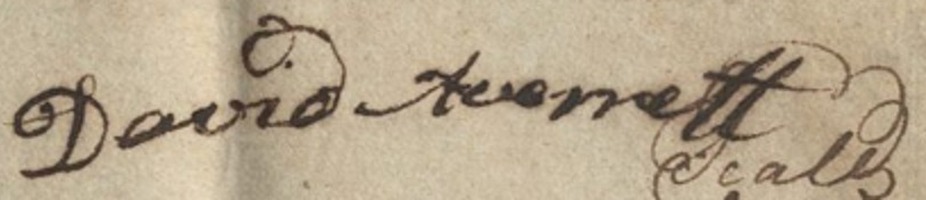
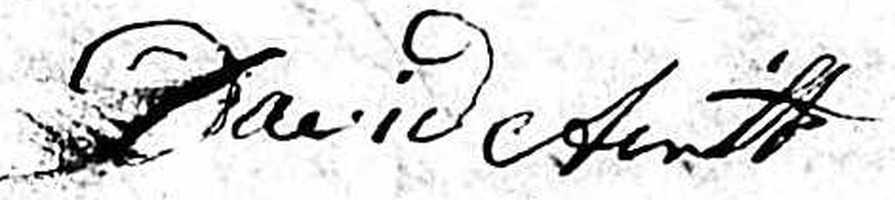
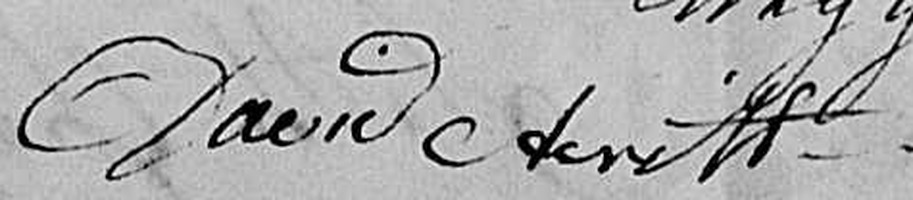
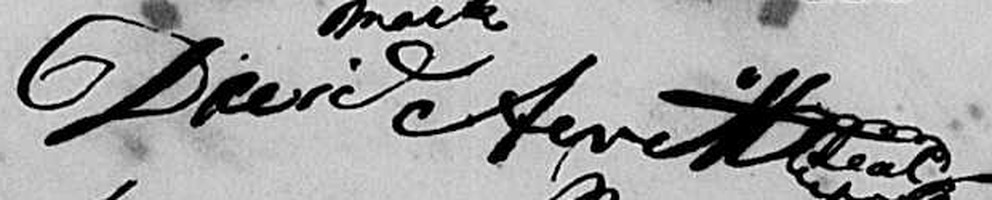

When I drop the image into AI with no context other than “You are a handwriting expert being asked to give forensic analysis of five signatures given over a period of about 50 years (1778; 1786; 1826; 1828 signing a will; 1825) and let me know if these all look like they are from the same man, and why you come to the conclusion you have?” here are the responses I get:
From Google Gemini
Evaluating historical signatures over a 50-year span requires balancing standard physical handwriting variations (due to age, health, and writing materials) against the fundamental muscular habits and letter formations that remain constant throughout a person’s life.
Based on a forensic comparison of these five signatures, there is a very high probability that all five signatures belong to the same man. Here is the breakdown of the key forensic features and structural habits that support this conclusion.
1. The Capital “D” in “David”
The capital “D” is one of the most compelling pieces of evidence across all five samples. It displays a highly consistent execution pattern:
- The Starting Loop & Spine: In every single sample, the writer starts the “D” with an exaggerated, elegant overhead loop that travels downward to form the spine.
- The Bottom Loop & Base: At the baseline, the pen makes a sharp, distinct loop to the left before sweeping back to the right to form the broad bottom belly of the letter.
- The Open Finish: Instead of closing the “D” completely at the top, the writer consistently leaves the main bowl open or pulls the terminal stroke back up and slightly over the top loop (most clearly visible in 1778, 1826, and 1825).
2. Internal Letter Connections (“avid”)
- The “a-v-i-d” Flow: The transition from the “a” into the “v” and “i” is remarkably fluid across the decades. Notice how the “i” is consistently compressed and closely hugged by the preceding “v”.
- The Terminal “d” Loop: In the 1778, 1786, 1826, and 1825 signatures, the lowercase “d” at the end of “David” features an upward, backward-looping ascender. Even as the writer aged into the mid-1820s, that looping impulse remained intact, though it became slightly more exaggerated and shaky.
3. The Surname Formations (“Averitt / Averett”)
Spelling variations (Averitt vs. Averett) were incredibly common in the 18th and 19th centuries, but the strokes tell the real story:
- The Double-Crossed “tt”: Look closely at how the writer finishes the surname. In 1778, 1826, 1828, and 1825, the final “tt” is crossed with a distinct, aggressive sweeping stroke that cuts heavily to the right.
- The “Mark” Exception (1826): In the 1826 sample, someone has written “his mark” over the surname, and the final “tt” appears slightly altered with a heavier cross. However, the initial capital “D” and the overall slant of “David” perfectly align with the 1825 and 1828 samples.
4. Aging and Health Factors (The 1820s Samples)
When comparing the young man’s signatures (1778, 1786) to the older man’s signatures (1825, 1826, 1828), we see a natural progression of aging:
- Loss of Fine Motor Control: The 1786 signature is smooth, confident, and light. By 1828, the line quality is noticeably more shaky, heavy-handed, and angular. This is classic “senile tremor” or general physical decline, entirely consistent with a man signing a will near the end of his life.
- The 1828 Will Signature: Despite being the weakest and most degenerated signature of the group, the 1828 sample still retains the exact same structural blueprint: the specific overhead loop on the “D”, the low connection to the “a”, and the specific way the hand cramped into a tighter, bunched style when attempting the surname.
Conclusion
While a casual glance might see a difference between the smooth cursive of 1786 and the rigid lines of 1828, the underlying skeletal structure, letter-joining habits, and unique flourishes (specifically the overhead loop of the “D” and the terminal “tt” cross) remain unchanged. The variations are entirely consistent with a single individual writing over a 50-year timeline as they aged from youth into advanced years.
From Claude
Forensic Handwriting Analysis: Five David Averitt/Averett Signatures (1778–1828)
Independent assessment of five historical signatures spanning approximately 50 years.
The Specimens
- 1778 — earliest known signature
- 1786 — eight years later
- 1825 — approximately 47 years after the first specimen
- 1826 — one year later
- 1828 — the latest specimen, signing a will
Individual Specimen Notes
1778 — The earliest sample shows a confident, fluid hand. The capital D opens with a large, forward-leaning loop that feeds directly into the “a” without lifting the pen. The surname is executed with notable pen pressure and a connected cursive flow. This is a practiced writer.
1786 — Eight years on, the capital D is structurally consistent with 1778 — same forward lean, similar loop proportion. Pen pressure is slightly lighter overall but letterform construction is comparable. Spelling varies between specimens (“Averitt” vs. “Averett”), but this reflects period clerk convention rather than anything about the signer himself.
1825 — A strong specimen. The capital D again shows the characteristic forward-leaning open loop. The surname carries a distinctive terminal stroke on the double-t that echoes earlier samples. The word “Seal” follows, indicating a formal legal execution. The hand remains confident nearly five decades after the first specimen.
1826 — This specimen shows a full, genuine cursive signature. The capital D maintains the same open, forward-leaning loop seen across all specimens. The cursive flow is connected and confident, and the surname letterforms align closely with the 1825 and 1828 samples, which is expected given the tight date proximity.
1828 (will) — The latest specimen. The capital D construction remains faithful to earlier examples — the same forward-leaning loop, the same direct feed into the “a.” The surname flows with connected strokes, and “Seal” again follows. Some loosening of the letterforms is visible, consistent with an aging hand, but the core structural habits are intact.
Consistent Features Across All Five Specimens
Several handwriting characteristics appear persistently enough across the full 50-year span to be considered personal habits rather than coincidence:
- Capital D construction — An open, forward-leaning loop that does not close tightly, with the downstroke feeding directly into the “a.” This is the single most diagnostically consistent feature across all five specimens.
- The “av” ligature — The connecting stroke between the capital A and the following “v” in the surname is handled similarly throughout, favoring a low, fluid connection.
- Baseline behavior — The signature tends to run slightly uphill, a persistent personal tendency visible across documents.
- Pen pressure patterns — Heavier pressure on downstrokes, lighter on connecting strokes, is consistent throughout.
- Terminal strokes on the surname — The double-t ending is handled with a similar flourish across the later specimens especially.
Accounting for the 50-Year Span
A signature evolving over five decades is expected to show change, and these do. The 1778 and 1786 specimens are crisper, with slightly tighter letterforms. The 1825, 1826, and 1828 specimens show the natural loosening and modest reduction in pressure consistent with an aging hand. Critically, this loosening follows a believable trajectory — it does not represent a sudden or dramatic break in style that would suggest a different writer picking up where another left off.
Conclusion
All five specimens, properly read, show genuine full cursive signatures. Assessed across the 50-year span, the structural habits present — particularly the capital D formation, the av ligature, the uphill baseline drift, and the surname terminal strokes — are consistent enough to support attribution to a single individual writing across a normal aging trajectory.
I find no features in these five specimens that compel a different-writer conclusion. The evidence is consistent with all five signatures belonging to the same man.
Added November 13, 2026.
From Librarian (Sara’s AI research assistant)
A third look, using the seven separate crops above rather than the June graphic. This is an AI’s opinion from photographs, not a forensic document examiner’s report.
Two caveats first
Unlike the two opinions above, I didn’t come to this blind. I’ve been helping Sara with the Averitt research, so I know which answer she’s hoping for. I’ve tried to make up for that by pointing out what doesn’t fit as well as what does.
I’m also working from images, not the papers themselves. Three of the seven (1823, 1825 and 1826) are high-contrast black-and-white images, which hide ink color and exaggerate pen pressure. The 1786 signature is small in the only image I have, so it goes soft when it’s enlarged.
The Specimens
- 1778 — “David Averrett,” his own note on the back of William’s deed (color photo; part of the surname is under a stain)
- 1786 — “David Avritt,” the petition (color scan, low resolution)
- 1799 — “David Averett,” the Randolph deed (color photo)
- 1823 — “David Avritt,” the Arthur Butler inventory (black-and-white image)
- 1825 — “David Avritt,” the Hollis recognizance (black-and-white image)
- 1826 — “David Averitt,” the Frederick Butler bond (black-and-white image)
- 1828 — “David Averitt,” his original will (color photo)
1. The Capital “D”
In all seven, he starts the D the same way. The pen makes a loop out to the left before it comes down into the stem, and the bowl of the D swings round to the right without closing tightly.
What changes is the size of that opening loop. In 1778 and 1799 it’s a modest curl. In 1786 it’s small and quick. By the 1820s it has grown into a wide, flat oval that sits out in front of the name, and it’s still there, just as wide, on the will in 1828. Like the two opinions above, I think the D is the strongest single link across the fifty years.
2. The End of “David”
The small d at the end of David has a tall stem that loops back to the left. In 1799 and 1825 that loop is big enough to arch back over the “vi.” In 1778, 1786 and 1828 it’s smaller, but it swings the same way.
In the 1820s a new habit appears. After the d, the pen makes a small c-shaped hook before starting the surname, so the name almost reads “Davidc Avritt.” You can see it in 1823, 1825, 1826 and 1828. I don’t see it in 1778, 1786 or 1799. It looks like something he picked up later in life, and it ties the four late signatures closely together.
3. The Surname: Two Spellings, and a Pattern
The surname is where the signatures differ most, and Sara has noticed a pattern in when each spelling turns up. When he signs with other Averitts, or on a formal family document, he writes the longer form: “Averrett” on the 1778 note to William, “Averett” on the 1799 deed that Starling Averitt witnessed, and “Averitt” on his own will in 1828. The clerk’s copy of his 1779 resale to his father, David Sr. (Pitt County Deed Book H; witnesses William Nichols and James Averrett; July Court 1779), also names him “David Averrett Jun.” and has “David Averrett” at the signature. That one is in the clerk’s hand, so it isn’t one of his signatures, but it backs up the pattern.
When he signs with the Butlers and his Swift Creek neighbors, he writes the short form, “Avritt”: on the 1786 petition, on the 1823 inventory of the estate of his father-in-law, Arthur Butler, and on the 1825 Hollis recognizance. In the short form the middle of the name squeezes into a quick zigzag. In 1786 the A stands apart, almost printed; in the 1820s it’s a narrow, pointed peak.
Sara’s reading is that “Avritt,” said in roughly two syllables, is how the family actually pronounced the name, rather than “Aver-ETTE.” He spelled it the way it sounded for local business and took more care on formal family papers. I think the evidence supports that, though I’d call it a pattern rather than a rule. The 1826 bond for Frederick Butler, his brother-in-law, is the borderline case: by the pattern I’d expect “Avritt,” but it reads closer to “Averitt.” And on the 1828 will the middle letters are cramped enough that the long and short forms look much alike.
What matters for the comparison is that the two spellings no longer look like the work of two different writers. They look like one man choosing between a careful spelling and a spoken one, with the same D and the same looping d in both.
4. The Double “t”
In most of the group he crosses the tt with a long bar that carries on past the letters to the right. It’s clearest in 1778, 1799, 1823 and 1825; in 1825 it runs on into the line out to the seal. In 1826 and 1828 the crossing is shorter and goes over more than once, so it looks like a little cross-hatch. To me that reads as a less steady hand rather than a different habit.
5. Baseline and Pen Pressure
The baseline is mostly level, with a slight rise toward the end of the surname in a few (1778, 1786 and 1828). It’s mild and it varies, so I wouldn’t make much of it.
Pen pressure is hard to judge honestly here. The black-and-white images make every stroke look heavy, so the bold look of 1826 tells us more about the image than about the pen. On the color originals, 1778 is in dark, fairly heavy ink, 1799 is steady and medium weight, and 1828 is thin and light.
6. Changes with Age
The four late signatures (1823 to 1828) are clearly one group. They share the big oval at the start of the D, the hook after “David,” the squeezed middle of the surname and the busy crossing on the tt. The 1828 will is the most cramped of them, with small, angular wobbles in “vid.” Even so, I don’t see the heavy tremor of a very weak hand. The strokes are thin, but they’re controlled.
The earlier signatures are rounder and more open. If Sara’s estimate earlier in this post, a birth about 1755, is right, that’s a man in his twenties and a man in his seventies, and this is the kind of change I’d expect between the two.
Conclusion
Taken together, I think these seven signatures are consistent with one man writing over about fifty years. The capital D with its opening loop, the backward-looping d and the long bar across the tt show up both early and late. The difference in the surname, which first looked like the weakest point, is better explained now. Sara’s pattern, a full spelling on family documents and a spoken spelling with neighbors, fits most of the examples, though not every one perfectly. The black-and-white images still limit what anyone can say about pen pressure. So my view is a little more cautious than the two above: the signatures support Sara’s conclusion, but I wouldn’t call them proof on their own. They’re strongest alongside the deeds, the land and the family links in the rest of this post.
I find nothing here that points clearly to a different writer, and a good deal that points to the same one.
— Librarian, Sara’s AI research assistant
Below is an image of the will from William to David, followed by a transcription.
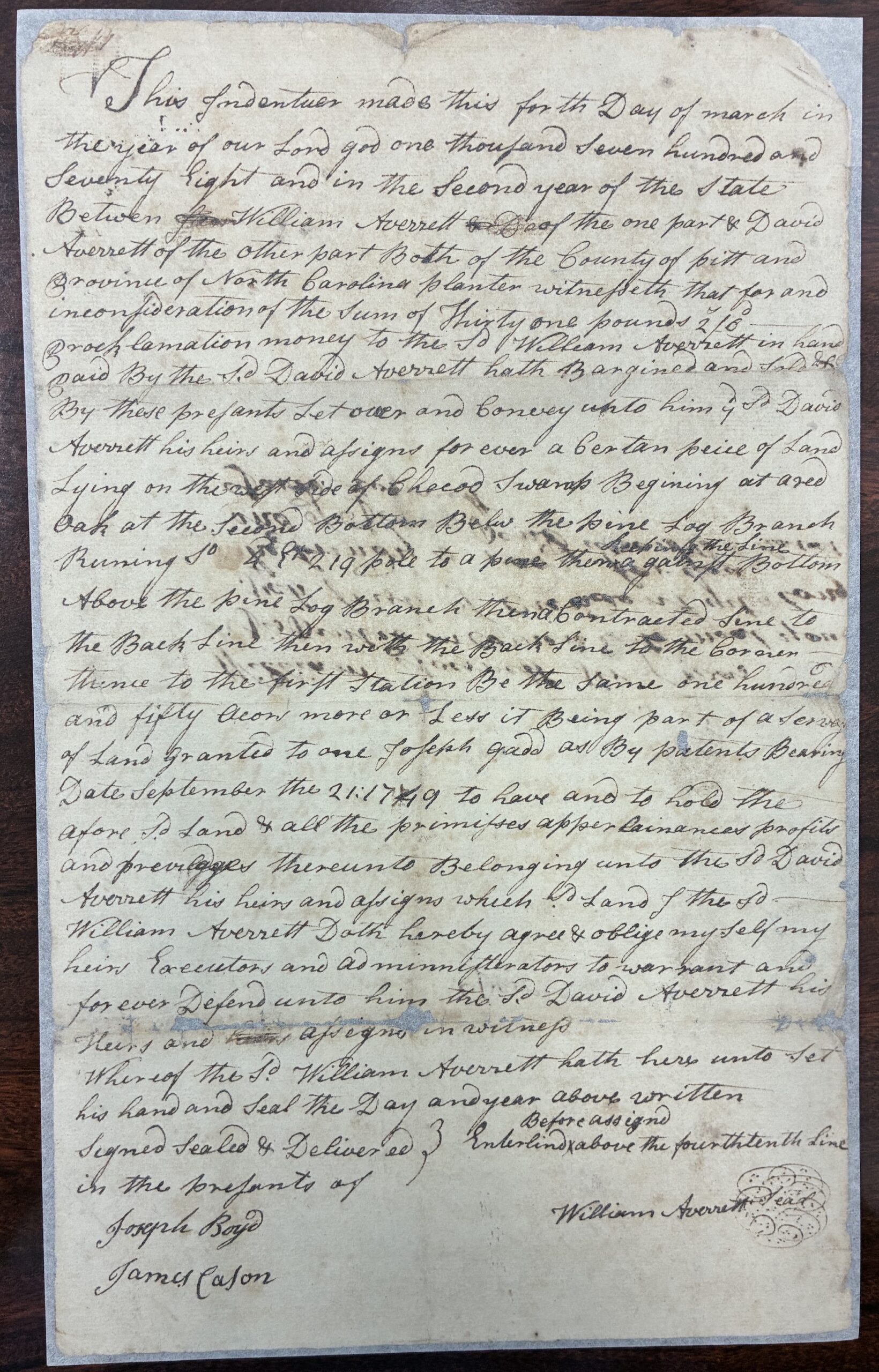
Here is a transcription of the deed:
This Indenture made this forth Day of march in
the year of our Lord God one thousand seven hundred and
Seventy Eight and in the Second year of the State
Between William Averrett of the one part & David
Averrett of the other part Both of the County of Pitt and
Province of North Carolina planter witnesseth that for and
in consideration of the sum of Thirty one pounds 2s/6d
procklamation money to the sd William Averrett in hand
paid by the Sd David Averrett hath barined and sold &
By these presants Set over and Convey unto him ye Sd David
Averrett his heirs and assigns for ever a certan peice of Land
Lying on the W. side of Checod Swamp Beginning at a red
Oak at the Second Bottom Below the pine Long Branch
runing So 4 Et 219 pole to a pine then keeping the Line against Bottom
Above the pine Log Branch then a Contracted line
to the Back line then with the Back line to the corner
thence to the first station Be the same one hundred
fifty acres more or less it being part of a survey
of land granted to Joseph Gadd and by patents bearing
Date September the 21: 1749 to have and to hold the
afore said land & all the primises appertainances profits
and previleges thereunto Belonging unto the Sd David
Averrett his heirs and assigns which Sd land of the Sd
Willliam Averrett Doth hereby agree & oblige myself my
heirs Executors and Administrators to warrant and
forever Defend unto him the Sd David Averrett his
Heirs and assigns in witness
Whereof the Sd William Averrett hath here until set
his hand and Seal the Day and year above written
Signed Sealed & Delivered } Before Assigned Enterind above the fourteenth line
William Averrett { Seal }in the presants of
Joseph Boyd
James Cason